Kumquat
Al-Qadri Nurseries has propagated many local and international citrus varieties to enrich the local market and meet farmers’ needs
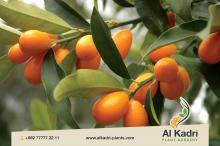
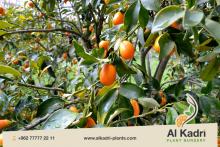
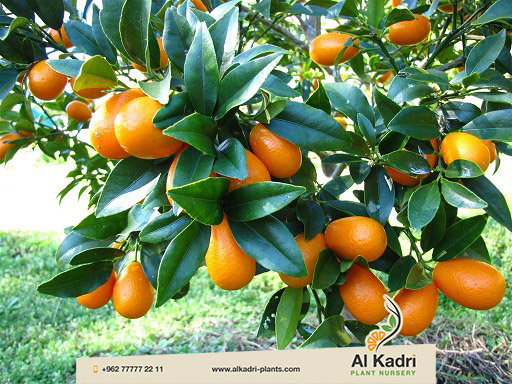
The kumquat tree is a small citrus fruit, orange in color
Each fruit weighs between 8 to 10 grams
The shape resembles a large olive and the taste is sweet
Eating seven fruits provides about 20% of the daily fiber and vitamin C requirement
It can be added to salads and seafood dishes
Tree Description
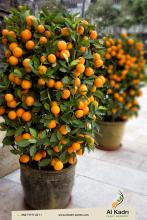
Kumquat shrubs grow slowly and are dwarf to small in size
Height ranges from 2 to 5 meters
Leaves are small, 3 – 6 cm in length
Fruits are small, 2-3 cm, either round or oval
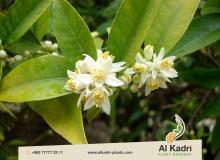
Trees bloom in spring with white flowers, either singly or in clusters in the leaf axils
Fruits are self-pollinating and mostly seedless
Also called golden orange or Japanese orange
The entire fruit is edible including the peel
Scientific Classification
Kingdom: Plantae
Division: Magnoliophyta
Class: Magnoliopsida
Order: Sapindales
Family: Rutaceae
Genus: Citrus
Subgenus: Fortunella
Suitable Conditions
Kumquats tolerate high heat, cold, and frost
Enter deep dormancy during winter in cold regions
In warm regions, trees can produce two crops per year
More cold-resistant compared to orange and mandarin
Suitable Soil
Grows well in all types of well-drained and mineral-rich soils
Water Requirements
Water moderately and increase watering during summer
Planting Distance and Pruning
Plant trees at 1.5 * 2 meters approximately
Or in rows at 1.5 * 3.5 meters
Prune to remove broken or dry branches
Can be shaped for decorative purposes in gardens or pots
Prune after harvesting and before flowering
Pests and Diseases
Susceptible to common citrus pests such as aphids, leaf miners, and mites
Excessive watering in pots may cause root rot
Also affected by scale insects
Kumquat Varieties
:Round fruits
Hong Kong Kumquat
Marumi Kumquat
:Oval/elongated fruits
Meiwa Kumquat
Nagami Kumquat